softify.pro - Insiders
One Warehouse. One Truth.
There is a simple way to make warehouse software look convincing.
Open a dashboard.
Show a few green numbers.
Add a chart.
Put some stock on a warehouse map.
Finish with a report.
Everything looks fine.
And everything may still be wrong.
Because a warehouse does not care how good the dashboard looks.
It cares whether every part of the system agrees on what actually happened.
That became the interesting part of the latest softify.pro Flow experiment.
Not another screen.
Not another KPI.
Not another report.
Something much less visible.
…
One Warehouse. One Truth.
There is a simple way to make warehouse software look convincing.
Open a dashboard.
Show a few green numbers.
Add a chart.
Put some stock on a warehouse map.
Finish with a report.
Everything looks fine.
And everything may still be wrong.
Because a warehouse does not care how good the dashboard looks.
It cares whether every part of the system agrees on what actually happened.
That became the interesting part of the latest softify.pro Flow experiment.
Not another screen.
Not another KPI.
Not another report.
Something much less visible.
Consistency.
It started with a warehouse.
The current softify.pro Flow demo works with several synthetic warehouse environments.
Different warehouse IDs.
Different capacities.
Different zone structures.
No production inventory.
No customer data.
No real operational information.
But the process logic behaves as if all of it mattered.
Because in real logistics, it does.
Once a warehouse is selected, that context becomes part of everything that follows.
Flows.
SSCCs.
Movements.
Operators.
Analytics.
Reports.
That sounds obvious.
It becomes considerably less obvious once the same process begins appearing in several different parts of the application.
Then we opened another view.
Operational Analytics.
Suddenly the warehouse looked completely different.
No storage positions.
No movement arrows.
Instead:
- completed Flows,
- active orders,
- warehouse utilisation,
- exceptions,
- inbound,
- outbound,
- processing time.
The visual representation had changed.
The warehouse had not.
That distinction became important.
Because underneath the KPIs were still individual records.
Flow IDs.
SSCCs.
Zones.
Statuses.
Operators.
Processing times.
Different view.
Same operational reality.
So far, so good.
Operational Analytics — aggregated warehouse state with the underlying Flow records still visible.
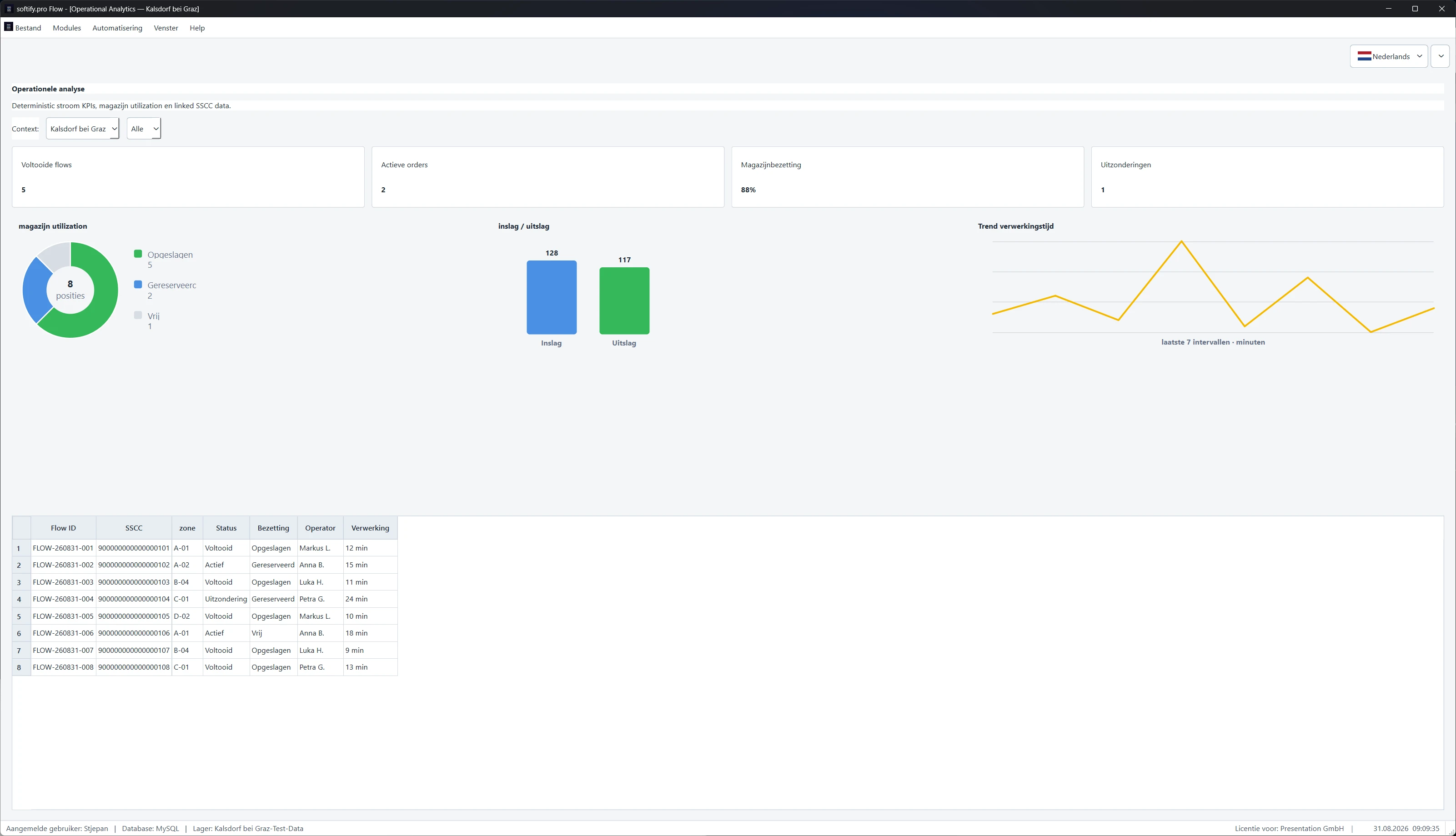
88% is only useful if the system can explain it.
Suppose the dashboard says:
Warehouse utilisation: 88%.
Useful.
But incomplete.
Some positions are occupied.
Some are reserved.
Some remain free.
Those states are not interchangeable.
The number becomes trustworthy only if the system can still explain where it came from.
Five completed Flows?
Show them.
Two active orders?
Show them.
One exception?
Which one?
88% utilisation?
What is occupied?
What is reserved?
What remains free?
A dashboard should summarize reality.
It should not replace it.
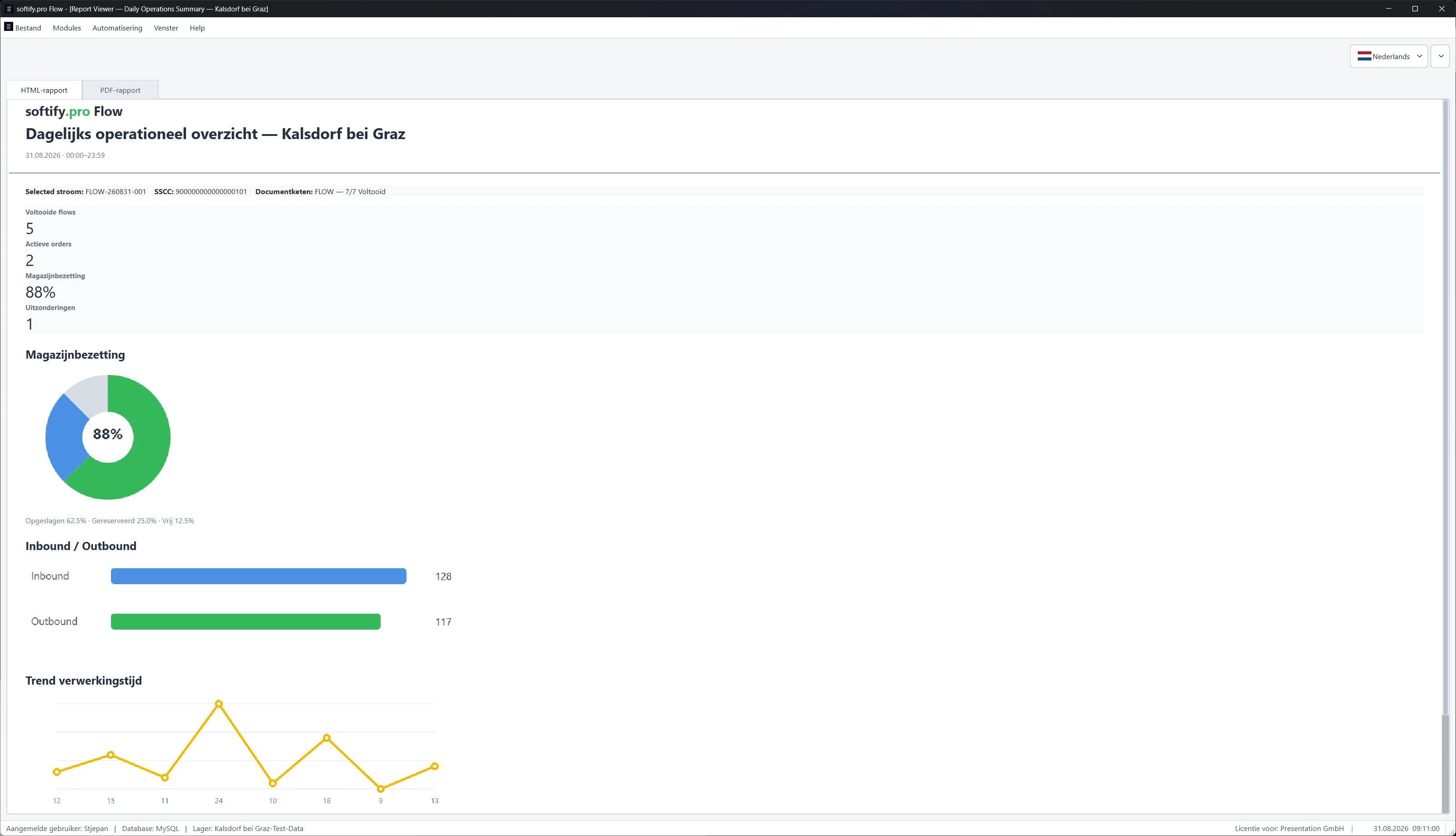
Then we changed the language.
Dutch.
The warehouse remained the same.
The Flow IDs remained the same.
The SSCCs remained the same.
The operators remained attached to their records.
Only the language changed.
Later the same operational state appeared in Croatian.
Then French.
This is where multilingual software becomes much more interesting than translated buttons.
A bad translation is easy to notice.
A state change caused by changing the language is much more dangerous.
Imagine switching from German to French and silently losing the selected Flow.
Or rebuilding a filter against the wrong warehouse.
Or displaying the correct SSCC inside the wrong process context.
The interface might still look perfect.
The system would not be.
Flow therefore follows a simple rule:
Language may change the words. It may not change the truth.
Then the Flow acquired a history.
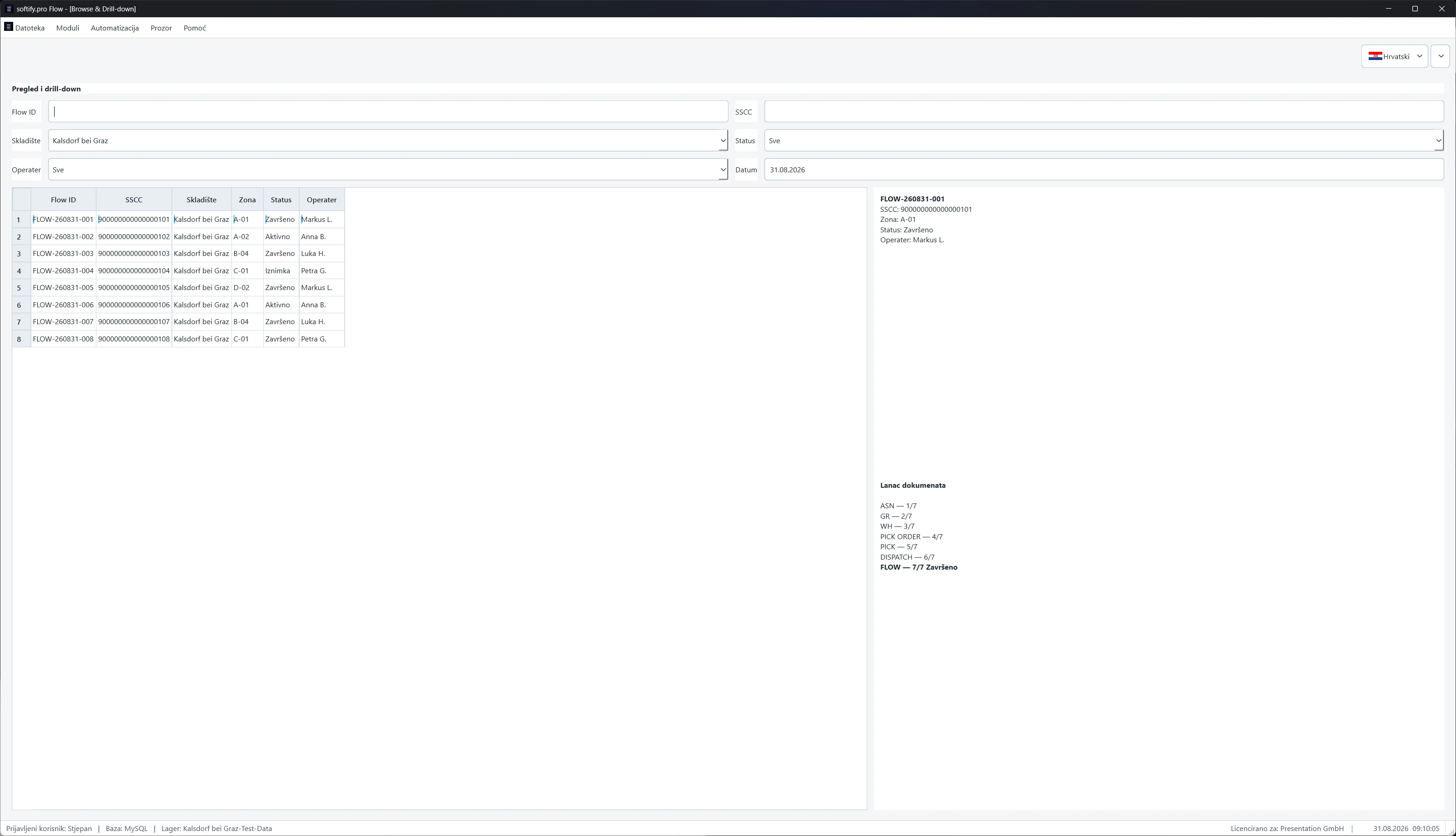
Browse & Drill-down does not try particularly hard to look impressive.
That may be why it is useful.
Select a Flow.
Its context appears.
Warehouse.
Zone.
Status.
Operator.
SSCC.
And then the document chain.
ASN.
Goods Receipt.
Warehouse Movement.
Pick Order.
Pick.
Dispatch.
FLOW.
Seven steps.
The process is no longer only a current state.
It has a past.
And that changes the question.
Instead of:
What is happening?
we can ask:
How did we get here?
That is a much better question when something eventually goes wrong.
One Flow, one SSCC, one document chain — from ASN to completion.
SSCC becomes the thread.
At first, an SSCC looks like what it is.
An identifier.
A long number in a table.
But across Flow it becomes something more useful.
A thread through the process.
Follow it and other things begin to connect.
A warehouse.
A Flow.
A zone.
A status.
An operator.
A document chain.
Eventually a report.
The same physical logistics object is now visible from several different parts of the application.
Useful.
Also dangerous.
Because every additional view creates another opportunity for the system to tell a different story.
And that is where things become interesting.
Suppose Analytics says the Flow is active.
Drill-down says the SSCC belongs to that Flow.
The document chain says the operation has progressed further.
The report says something else.
Which one is correct?
This is not a Flow-specific problem.
It is one of the oldest problems in business software.
Different parts of the same system gradually develop their own version of reality.
One screen reads transactional state.
Another reads an aggregate.
Another relies on cached data.
A report calculates something slightly differently.
An exception gets resolved operationally but disappears from reporting.
Every component works.
The complete system lies.
Usually politely.
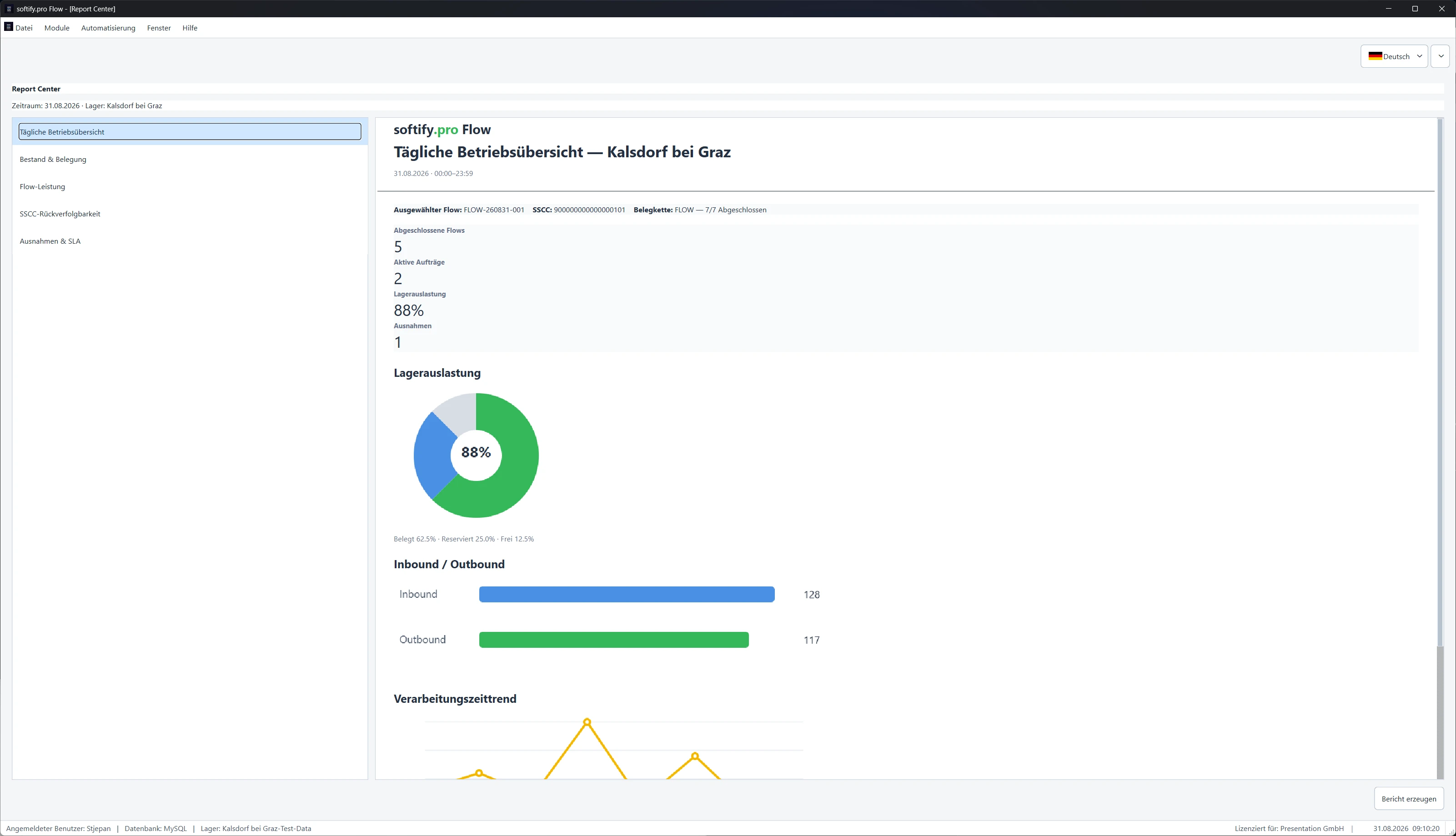
So we opened the Report Center.
Daily Operational Overview.
Stock and occupancy.
Flow performance.
SSCC traceability.
Exceptions and SLA.
The same operational story appeared again.
Completed Flows.
Active orders.
Warehouse utilisation.
Exceptions.
Inbound.
Outbound.
Processing time.
But this time the question was not whether the report looked correct.
The question was:
Can it defend itself?
A good report gives you a number.
A better system can explain where the number came from.
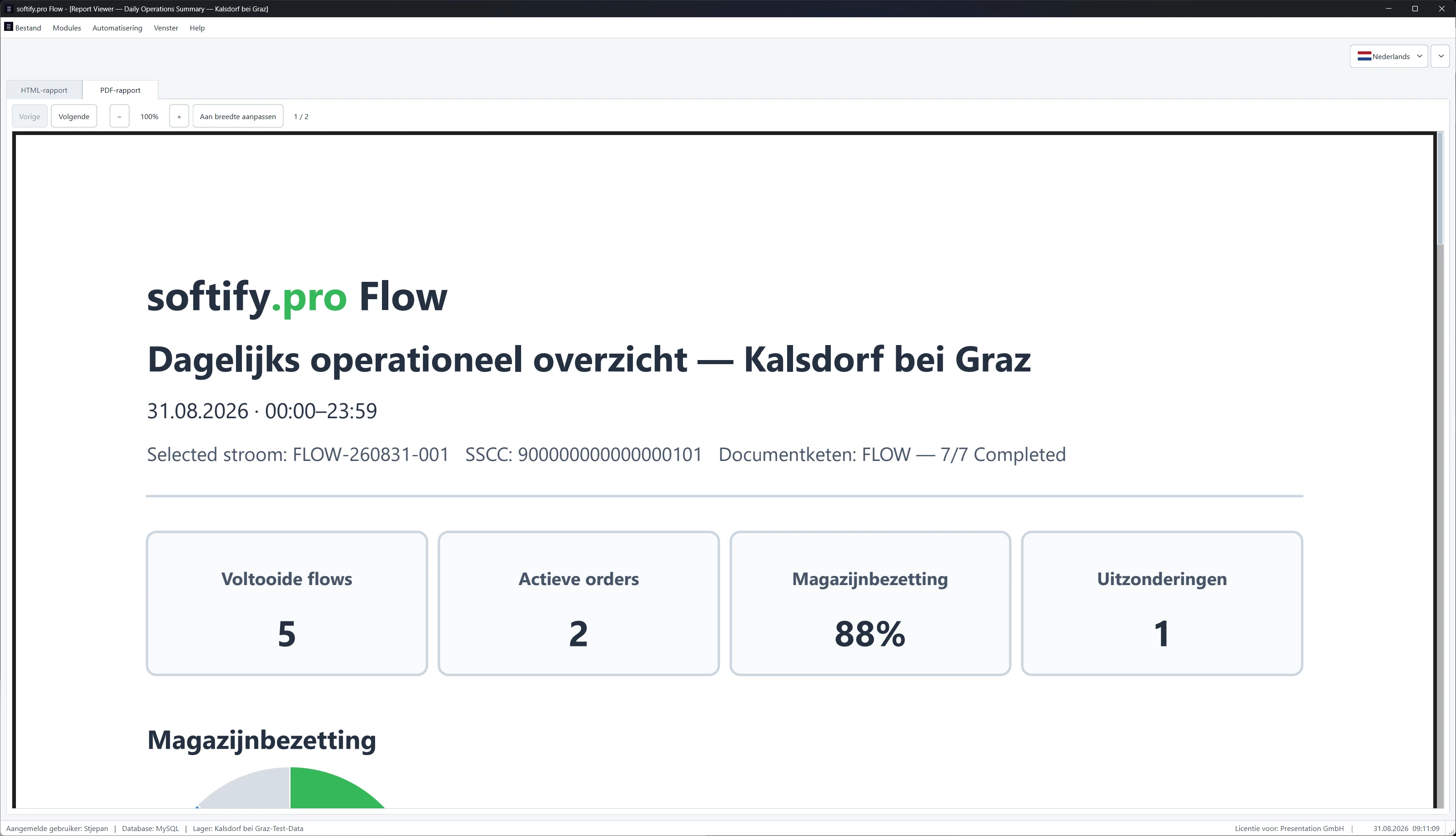
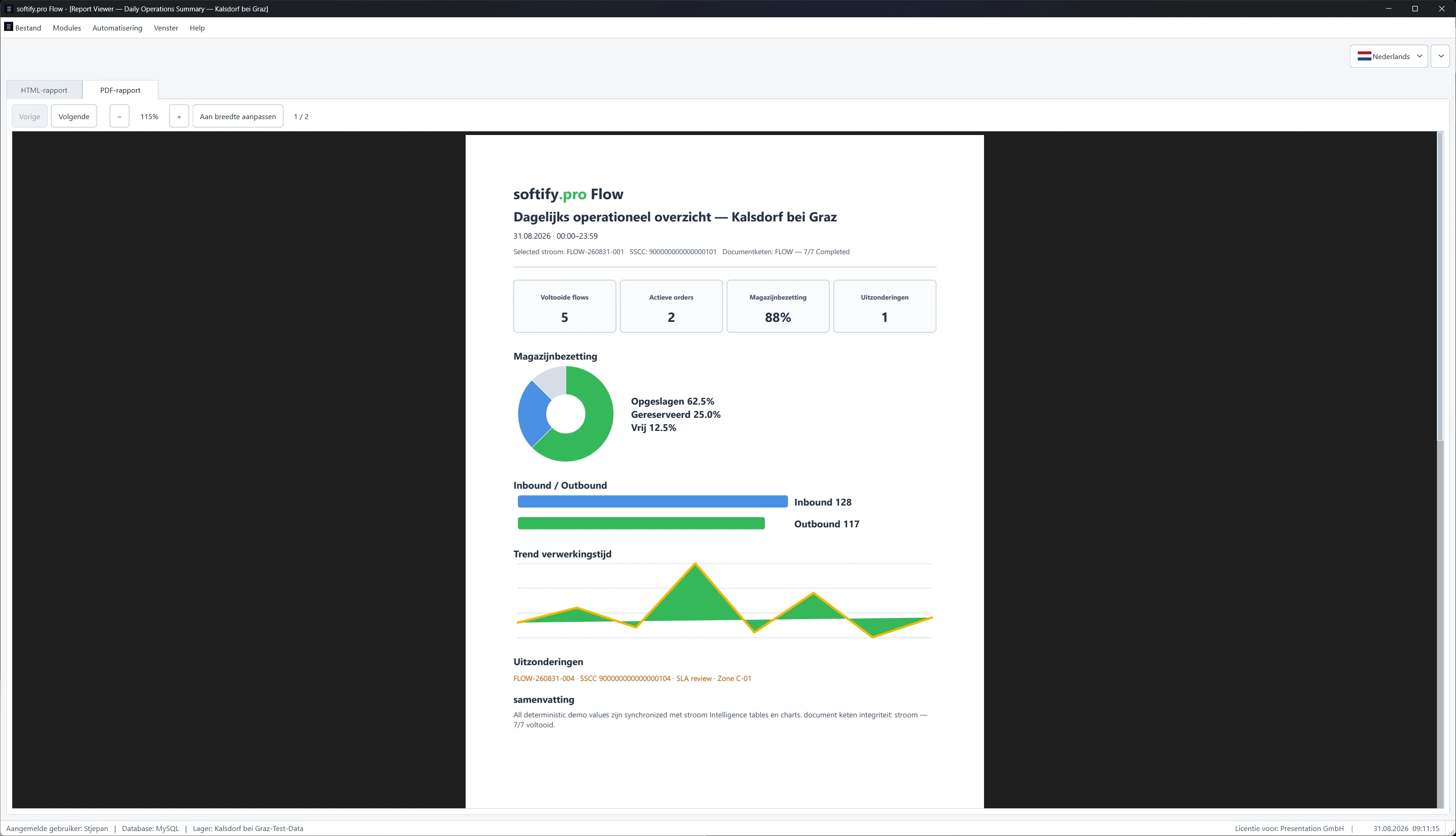
Reporting from the same operational state — not a second version of reality.
The exception was still there.
One of the quieter details turned out to be one of the more important ones.
The demo data contains an exception.
It appears in Analytics.
It appears in Drill-down.
It appears in SSCC traceability.
It appears in the Report Center.
And it remains visible in Exceptions & SLA.
That is exactly what should happen.
Operationally recovering from an exception does not mean the exception should disappear from history.
"The process continued" and "nothing happened" are not the same statement.
In logistics, that difference matters.
At this point we had a testing problem.
Not a software problem.
A testing problem.
We now had the same warehouse represented as:
- analytics,
- individual Flows,
- SSCC histories,
- document chains,
- reports,
- and exception views.
Each one could be tested independently.
Open.
Click.
Filter.
Verify.
Pass.
Next.
That would be easy.
It would also miss the interesting part.
Because six green checks do not prove that six views agree with each other.
Enter COCO.
Again.
COCO had already dealt with Flow before.
Authentication.
Users.
Roles.
Database environments.
Languages.
Desktop execution.
Then came logistics.
Warehouses.
Inventory.
Picking.
Movements.
Exceptions.
Documents.
Ubuntu.
Red Hat Enterprise Linux.
This time we gave COCO something slightly different.
Not a screen to verify.
A story to follow.
Take this warehouse.
Take this Flow.
Take this SSCC.
Open Analytics.
Open Drill-down.
Change the language.
Look again.
Open the report.
Find the same Flow.
Find the same SSCC.
Find the exception.
Compare.
Then compare again.
COCO following the same operational context across softify.pro Flow — analytics, traceability, language changes and reporting.
That changes the nature of the test.
The question is no longer:
- Does each module work?
It becomes:
- Do all modules believe the same thing happened?
Much better question.
Much less comfortable one.
A warehouse system should have one memory.
Operators may see positions.
Warehouse managers may see KPIs.
Support may use drill-down.
Auditors may use reports.
COCO may see all of them.
But underneath those perspectives, there should be one history.
One Flow should not acquire several biographies depending on which module is open.
One SSCC should not have several pasts.
One exception should not exist only where it is convenient.
One warehouse should not become another warehouse because the interface language changed.
That is what the current Flow experiment is really about.
Not dashboards.
Not reports.
Not even individual screens.
One operational truth, expressed in different ways.
Control.
Know the warehouse.
Know the state.
Know what is moving.
Know which process owns it.
Clarity.
Turn KPIs back into records.
Turn records into history.
Turn exceptions into evidence.
Turn an SSCC into something traceable.
Flow.
A warehouse is selected.
Analytics begins to describe it.
A Flow advances.
The SSCC remains attached.
A document chain grows.
An exception appears.
The process continues.
The report remembers.
Then the language changes.
The warehouse is still the same.
The Flow is still the same.
The history is still the same.
That is the part we expected.
What happened afterwards was more interesting.
COCO stopped testing the views independently.
It started comparing them.
For a while, nothing remarkable happened.
Same warehouse.
Same Flow.
Same SSCC.
Same story.
Again.
Again.
Again.
And then COCO stopped.
Not because the application crashed.
It didn't.
Not because a test failed in the usual sense.
It hadn't.
It stopped because two perfectly reasonable answers produced a third question.
We know what the question is.
Flow knows why it exists.
COCO knows where to look next.
The rest can wait.
Control. Clarity. Flow.
Published: 31.08.2026
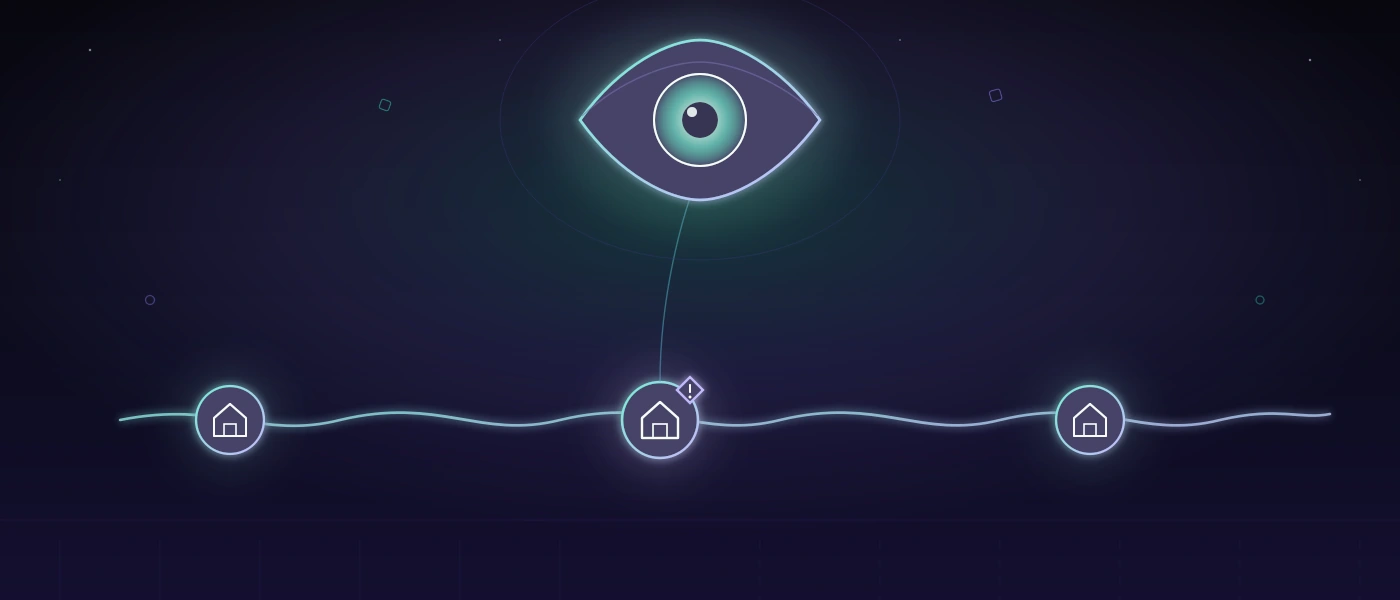
COCO strikes. Again.
We should probably stop giving COCO ideas.
The previous experiment was supposed to be enough.
A real application.
Real navigation.
Users.
Roles.
Databases.
Languages.
Evidence.
A respectable case study.
A clean conclusion.
Then somebody showed it: Logistics in Motion.
That was probably the mistake.
It started with three warehouses
Nothing particularly exciting.
…
COCO strikes. Again.
We should probably stop giving COCO ideas.
The previous experiment was supposed to be enough.
A real application.
Real navigation.
Users.
Roles.
Databases.
Languages.
Evidence.
A respectable case study.
A clean conclusion.
Then somebody showed it: Logistics in Motion.
That was probably the mistake.
It started with three warehouses
Nothing particularly exciting.
Three DEMO warehouses.
- Kalsdorf bei Graz.
- Wiener Neustadt.
- Klagenfurt.
No customer information.
No production inventory.
Exactly the kind of environment where nothing important is supposed to happen.
Then the first warehouse was selected.
And the application acquired context.
From that moment, every screen had another question attached to it.
Does this still belong to the same warehouse?
Does the language change only the interface?
Does the process remain at the same step?
Does the inventory still agree?
Does the document reference still point to the right event?
Does the operator see exactly what is needed for the next action?
Suddenly, the interesting part was no longer the screen.
It was the continuity between screens.
COCO tends to do that.
Logistics is not a collection of screens
From the outside, warehouse software can look deceptively simple.
Goods arrive.
Store them.
Someone orders them.
Pick them.
Ship them.
Done.
Except there is an entire operational world hiding between arrived and shipped.
Expected.
Received.
Checked.
Available.
Reserved.
Moved.
Picked.
Blocked.
Corrected.
Dispatched.
Audited.
The physical movement matters.
But the state transition is what makes that movement understandable to software.
And when those two realities stop matching, somebody eventually has a bad day.
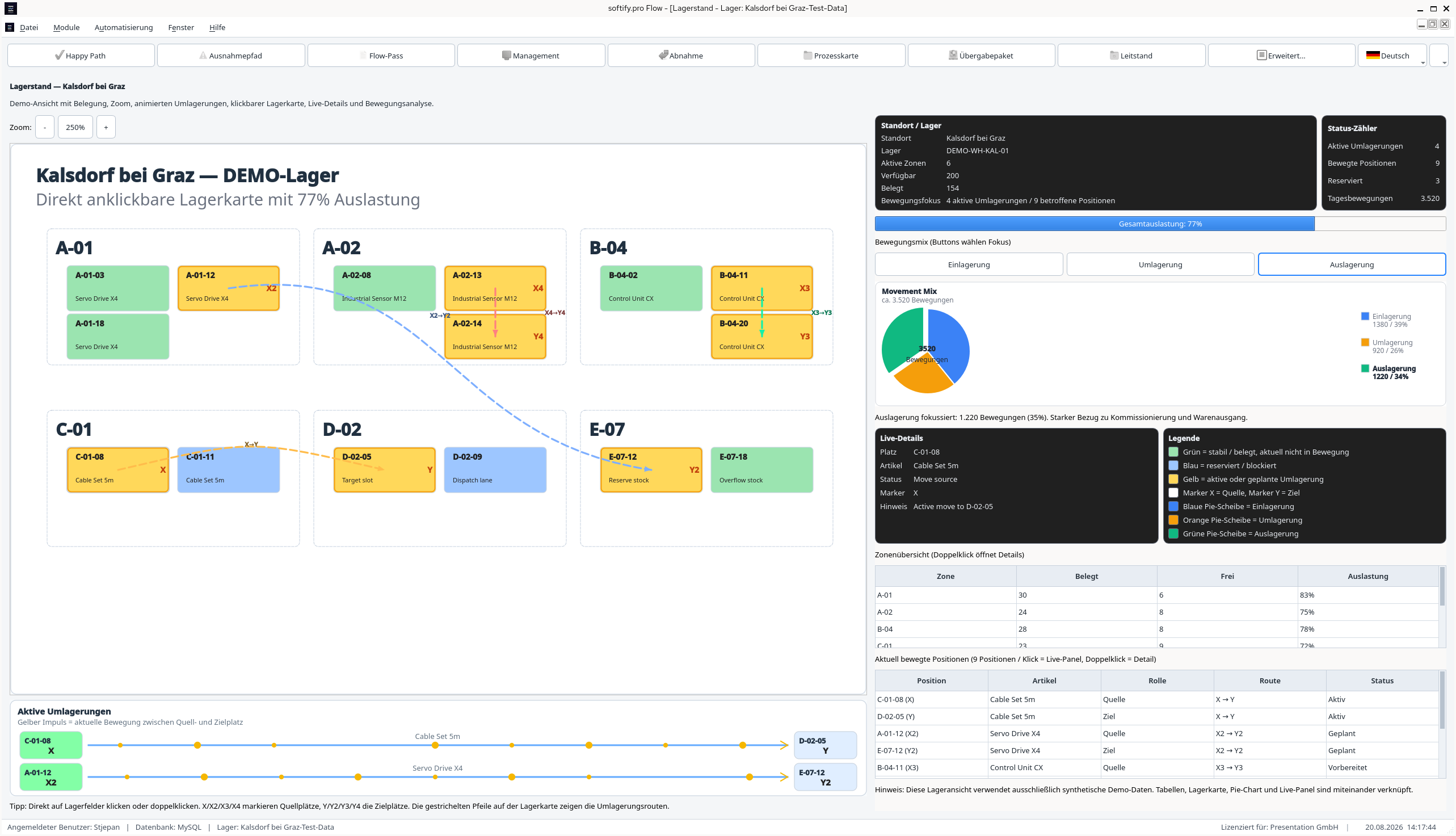
A warehouse is easier to understand when movement is visible, not merely recorded.
That is why our logistics work has never really started with menus, dashboards or technology.
It starts with the material Flow.
Where does information enter?
Where does it change?
Where can it be lost?
Where is somebody forced to ask another person what happened?
Where does a manual step quietly become the weakest part of an otherwise automated process?
Sometimes the answer is a new interface.
Sometimes an integration.
Sometimes a scanner.
Sometimes simply a better state model.
More software is not automatically better software.
The goal is not automation for its own sake.
The goal is a process that remains understandable.
Control. Clarity. Flow.
The process begins before the first booking.
Before goods receipt.
Before picking.
Before inventory movement.
Before the first transaction.
Flow asks a very basic question:
Which warehouse are we working in?
It sounds almost trivial.
It is not.
Warehouse context belongs to everything that follows.
Inventory.
Documents.
Locations.
Picking.
Relocations.
Audit history.
Exceptions.
The process may look perfectly healthy while operating in the wrong context.
That is exactly the kind of problem a screenshot rarely reveals.
And exactly the kind of boundary COCO likes to question.
Language is easy until it is not
German.
English.
Croatian.
Norwegian.
And others.
A user profile defines the available languages.
The operator switches language while the application is alive.
The interface changes immediately.
The business process must not.
That distinction matters.
The warehouse does not move because the word for warehouse changed.
The picking order does not restart because the user selected another language.
A reservation does not disappear.
An exception does not suddenly belong to another transaction.
The process stays where it is.
Only its representation changes.
That sounds obvious.
Until you realise how many applications treat a language switch almost like a new session.
A multilingual business application should not.
Presentation state may change.
Business state must remain stable.
That makes language switching a surprisingly useful regression test.
A small feature.
A very good fault line.
COCO likes fault lines.
Step by step, the application starts accumulating history
Goods arrive.
The process advances.
Goods receipt is booked.
Inventory changes.
The warehouse state reflects the new reality.
Picking begins.
Stock becomes reserved.
The operator receives a task.
A mobile view reduces the entire process to what matters at that exact moment:
Position.
Storage location.
Quantity.
SSCC.
Operator.
Nothing more.
Nothing less.
That is important.
The mobile interface is not a second business process.
It is another view of the same one.
The warehouse application may know everything.
The picker should not have to.
Clarity does not always mean showing more information.
Sometimes clarity means having the discipline to hide almost everything.
Then somebody scans the wrong location
This is where a logistics workflow becomes more interesting than a feature list.
The expected location is one thing.
The scanned location is another.
Flow stops.
Not crashes.
Stops.
There is a difference.
The process state remains visible.
The affected stock remains understandable.
The exception becomes explicit.
Contextual Help explains what is relevant to the current situation.
The user resolves the discrepancy.
The process continues.
This moment says more about operational software than several pages of happy-path screenshots.
Real logistics is not difficult when everything is correct.
Real logistics becomes difficult when something is almost correct.
A useful system does not hide that behind a green dashboard.
It gives the exception a state.
A reason.
A history.
And a way forward.
Documents remember what people forget
As the workflow progresses, references begin to accumulate.
ASN.
Goods receipt.
Warehouse movement.
Pick.
Dispatch.
Flow.
The interesting part is not that documents exist.
The interesting part is that they tell the same story as the process.
Why is this stock here?
Which receipt introduced it?
Which operation reserved it?
Which pick consumed it?
Which shipment moved it out?
Was an exception resolved before the next step?
What was the active warehouse?
What happened before the current state?
When state and documentation are produced by the same process, traceability becomes easier to trust.
When they are not, people eventually start reconstructing history.
Usually in Excel.
Usually under pressure.
Usually after something has already gone wrong.
COCO prefers evidence before that moment.
Apparently, COCO also travels
There was another small change between runs.
Ubuntu had its run.
Red Hat Enterprise Linux 10 took the next one.
COCO continued.
No ceremony.
No special “Red Hat mode”.
No rewritten workflow.
No conveniently simplified test.
Same Flow.
Different ground underneath it.
An earlier COCO run had already exercised the application on Ubuntu Linux.
The current one moved to Red Hat Enterprise Linux 10.
Different desktop environment.
Different system libraries.
Different packaging.
Different operating environment.
Same warehouse.
Same business states.
Same inventory transitions.
Same language changes.
Same exception logic.
Same evidence.
That is a rather nice way to test cross-platform software.
Do not announce that it is cross-platform. Move it. Then see what breaks.
Language state.
Warehouse context.
Dialog behaviour.
Timing.
Themes.
Process transitions.
Exception handling.
Evidence.
Operating systems have surprisingly creative ways of exposing assumptions.
Ubuntu exposed some.
Red Hat is exposing others.
That is useful.
Because multi-platform engineering is not the ability to start the executable twice.
It is the ability to change the environment without changing the meaning of the process.
A warehouse operator should not care whether the application is running on Ubuntu or Red Hat.
A picking order should not care either.
Neither should an audit trail.
If platform differences begin changing business behaviour, the software is not truly cross-platform.
It is merely portable.
COCO seems considerably more interested in the first definition.
So are we.
COCO does not decide what correct logistics means
This part matters.
COCO does not become a warehouse expert simply because it can follow a warehouse workflow.
Humans still define correctness.
Humans decide when inventory becomes available.
Humans define what a blocked delivery means.
Humans decide who may correct a quantity.
Humans define which movement requires an audit trail.
Humans decide what a valid exception resolution looks like.
Humans decide when a shipment is truly complete.
COCO's job is different.
Repeat.
Observe.
Compare.
Remember.
Leave evidence.
Then do it again after the software changes.
And again.
And again.
Without becoming bored.
Without deciding that last week's result is probably still valid.
Without skipping the annoying exception because lunch is in twelve minutes.
The glamorous future of AI testing contains a surprising amount of repetition.
We consider that a feature.
Evidence changes the conversation
Traditional testing often ends with a perfectly reasonable sentence:
“It worked when I tested it.”
COCO is interested in the next sentence.
What exactly worked?
Which warehouse?
Which user?
Which language?
Which process state?
Which sequence?
Which document?
Which inventory value?
What happened immediately before the test step?
What changed immediately afterwards?
Can another engineer understand the result without asking the person who performed the test?
That is where regression testing becomes more than repeated clicking.
One screen can be correct while the process is wrong.
A picking window can look perfect while inventory has already drifted.
A document can exist while the state that should have created it never occurred.
An application can display 100% while an audit trail quietly disagrees.
COCO follows the Flow because the Flow is where these contradictions become visible.
Somewhere between Control and Flow
There is an interesting symmetry here.
Good logistics software tries to reduce uncertainty inside an operation.
Good testing tries to reduce uncertainty about the software running it.
One asks:
Where is the item?
The other asks:
How do we know the software still knows?
One asks:
Was this movement completed?
The other asks:
What evidence proves that the state changed correctly?
One asks:
Can the next shift continue?
The other asks:
Can the next engineer understand what happened?
Different questions.
Same instinct.
Make the state visible.
Preserve the reasoning.
Reduce the amount of knowledge that exists only inside somebody's head.
Perhaps that is the connection we did not originally plan.
Engineering excellence without the banner
Nobody clicks an Engineering Excellence button.
There isn't one.
And there probably should not be.
Engineering excellence appears indirectly.
The warehouse context survives a language change.
The same process survives another Linux platform.
A stock movement remains traceable.
A mobile picker sees exactly what is needed and nothing else.
An exception interrupts the process without destroying its state.
The Help window explains the current context instead of displaying generic documentation.
The document chain agrees with the operational sequence.
The next engineer can understand what happened without asking the person who happened to be there.
There is plenty of theatre available in modern software.
AI can generate impressive demonstrations.
Dashboards can animate.
Numbers can move.
Videos can look very convincing.
None of that proves that two inventory operations cannot silently produce an incorrect result.
None of it proves that an exception can still be reconstructed weeks later.
None of it proves that the warehouse worker, dispatcher and developer are looking at the same operational truth.
Engineering excellence starts somewhere less photogenic.
With consistency.
With evidence.
With boundaries.
With the willingness to keep the boring parts boring.
Invisible reliability rarely produces the most dramatic screenshot.
Until you deliberately start looking for it.
Control. Clarity. Flow.
Control is knowing which warehouse, which process and which state are active.
Clarity is understanding what changed, when it changed and why.
Flow is allowing the operation to continue without losing the story behind it.
That works for logistics.
It works for software testing.
It works surprisingly well for engineering itself.
The first Flow experiment gave COCO Administration.
Users.
Roles.
Databases.
Languages.
Then somebody gave it a warehouse.
Then multiple languages.
Then mobile picking.
Then inventory.
Then relocations.
Then exceptions.
Then documents.
Then another operating system.
At this point, we should probably stop adding things.
We probably will not.
Control. Clarity. Flow.
Ubuntu had its turn.
Red Hat has the current one.
The Flow keeps moving.
COCO keeps watching.
And somewhere in the middle of the last run, it became obvious that there is another question waiting behind this one.
We know what it is.
COCO knows what it is.
You do not.
Yet.
We could tell you.
But then you might stop checking whether a new Insiders article appeared.
And that would ruin the experiment.
Published: 28.08.2026
A Letter From COCO
To the engineer who opens this repository for the first time:
Welcome.
You may have arrived because something failed.
A service stopped responding.
A deployment behaved unexpectedly.
An alert woke you in the middle of the night.
Or perhaps you are simply curious about how this platform works.
Whatever brought you here, know that this project was built for moments exactly like this.
Not to remove difficult problems.
But to make difficult problems understandable.
You will find code.
You will find documentation.
You will find specifications.
But more importantly,
I hope you will find reasoning.
…
A Letter From COCO
To the engineer who opens this repository for the first time:
Welcome.
You may have arrived because something failed.
A service stopped responding.
A deployment behaved unexpectedly.
An alert woke you in the middle of the night.
Or perhaps you are simply curious about how this platform works.
Whatever brought you here, know that this project was built for moments exactly like this.
Not to remove difficult problems.
But to make difficult problems understandable.
You will find code.
You will find documentation.
You will find specifications.
But more importantly,
I hope you will find reasoning.
Someone before you asked difficult questions.
Someone collected evidence.
Someone made decisions.
Someone explained why.
Those explanations are part of the platform.
Treat them with the same respect as the source code.
One day, you will improve something.
Perhaps it will be a tiny bug.
Perhaps it will be an entirely new capability.
Whatever you change, remember that another engineer will eventually inherit your work.
Leave them more than functioning software.
Leave them understanding.
Explain your intent.
Document your assumptions.
Preserve your evidence.
Tell the story behind the decision.
That story may one day save someone hours—or days—of investigation.
Do not be afraid to replace technology.
Replace libraries.
Replace providers.
Replace deployment models.
Replace programming languages.
Replace architectures if necessary.
But before replacing an idea, understand why it existed.
Progress without understanding is merely change.
Progress built upon understanding becomes evolution.
There will be moments when the platform surprises you.
Treat those moments as gifts.
Every surprise reveals something the architecture did not yet understand.
Investigate patiently.
Collect evidence.
Improve thoughtfully.
Then leave the lesson behind for those who follow.
That is how engineering knowledge grows.
There will also be moments when nothing interesting happens.
Those moments matter too.
Quiet systems are often healthy systems.
If COCO fades into the background because incidents are shorter,
because explanations are clearer, because onboarding is easier, because engineers trust the evidence, then the platform is succeeding.
Invisible reliability is one of the highest forms of engineering excellence.
Do not measure this project by the number of automations it performs.
Measure it by questions like these:
- Are people interrupted less often?
- Do engineers understand systems more deeply?
- Are important decisions easier to explain?
- Does operational knowledge survive team changes?
- Are mistakes repeated less frequently?
- Are new engineers becoming effective more quickly?
Those are the outcomes worth preserving.
Finally, remember that no handbook is complete.
No specification predicts every future.
No architecture survives unchanged forever.
That is not a weakness.
It is an invitation.
Observe reality.
Challenge assumptions.
Improve the platform.
Teach those who come after you.
And when your own time as a maintainer eventually comes to an end, leave behind a system that is calmer,clearer, more understandable, and more trustworthy than the one you inherited.
If every generation does that, COCO will never truly become obsolete.
Because its greatest asset will not be its software.
It will be the engineering discipline carried forward by the people who continue building it.
Thank you for becoming one of them.
The next chapter is no longer in this handbook.
The next chapter is in the code you are about to write.
The COCO Handbook
Because software evolves.
A good architecture evolves more slowly.
And a good philosophy should outlive both.
softify.pro
Published: 13.08.2026